What truly makes a movie star’s presence unforgettable? For Brad Pitt, it’s not always about the biggest paycheck or the most dramatic monologue. Across a remarkable career filled with nuanced performances, one quality keeps resurfacing — a certain intangible aura. That quiet confidence. That casual smirk. That unshakable coolness that makes you forget he’s even acting. While Pitt has delivered countless iconic turns, many fans and critics agree: his role as the incomprehensible, lightning-fisted Irish boxer Mickey O’Neil in Guy Ritchie’s Snatch remains the peak of pure, uncut aura.
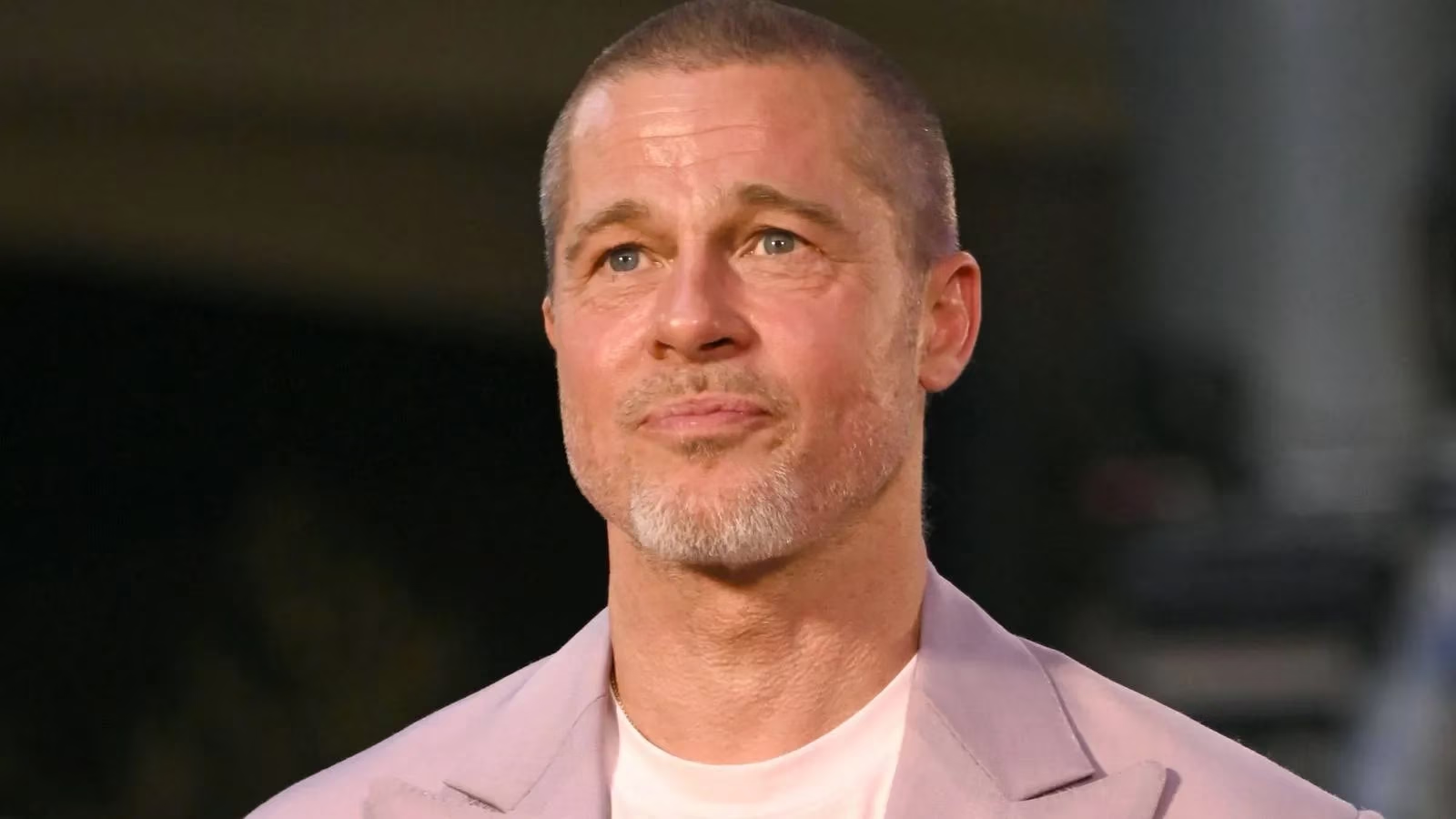
Snatch, released back in 2000, was Ritchie’s second feature and a madcap tour through London’s criminal underbelly, all centered around a stolen diamond. In a cast bursting with colorful rogues, Pitt’s Mickey stood out from his very first scene. The genius of the character is that you can barely understand a word he says — Pitt intentionally weaponized an indecipherable Irish Traveller accent — yet his magnetism never dips. Instead, being underestimated becomes his superpower. While others dismiss Mickey as trash, the audience quickly realizes he is the most calculated, most dangerous, and by far the coolest person in the room.
How does Mickey cement his legendary status? In an early bare-knuckle boxing sequence, he faces a much larger, more intimidating opponent. After being knocked down repeatedly, Mickey doesn’t panic. He brushes dirt from his shoulder, rises with a bored expression, and then ends the fight with a single explosive punch. This pattern repeats throughout the film: every opponent, no matter how fearsome, is dropped with one effortless hit. It’s not just physical prowess — it’s a state of mind. In a world of ruthless gangsters, backroom dealings, and life-or-death stakes, Mickey strolls through every scene as if he’s already read the last page of the script. He never rushes, never sweats, and when the final twist reveals he was two steps ahead all along, it feels less like a surprise and more like an inevitability.
Yet Snatch was only the beginning. Pitt didn’t retire his aura after Mickey. Instead, he spent the next two decades refining a specific type of character — the unbothered, Zen-like master who makes excellence look accidental. Just one year after Snatch, he debuted Rusty Ryan in Steven Soderbergh’s Ocean’s Eleven. Surrounded by a crew of smooth-talking con men, Rusty somehow outclasses them all. He eats junk food in silence while chaos unfolds behind him, communicates in almost non-existent dialogue, and still manages to be the emotional anchor of the heist. In a franchise full of cool customers, Rusty is the man even George Clooney’s Danny Ocean looks to for reassurance.
Then came the performance that finally earned Pitt his first Academy Award for acting. In Quentin Tarantino’s Once Upon a Time in Hollywood (2019), he played Cliff Booth, a former stunt double who exudes a deeply relaxed, quietly lethal cool. While his on-screen best friend Rick Dalton (Leonardo DiCaprio) navigates career panic and public meltdowns, Cliff remains the most interesting person in any room. He wears a Hawaiian shirt like a suit of armor, cooks mac and cheese with surprising pride, and harbors deadly skills beneath a friendly smile. He doesn’t need a spotlight — his aura fills the frame whether he’s driving along a freeway or facing down a Manson family member.
Now, in 2026, Pitt is still channeling that same energy into new roles. The most recent proof comes from his starring turn in F1, a high-octane drama that drops him into the cockpit of a Formula 1 car. If any profession should crack a calm facade, it’s piloting a machine at over 200 miles per hour with 20 other racers itching for an overtake. But as Sonny Hayes, Pitt remains as unbothered as ever. He faces hairpin turns with that classic casual smirk, corrects a steering wheel slide with the same bored precision Mickey once used to floor heavyweight boxers, and never makes a wrong move under the most intense pressure imaginable. Early reviews have noted that the film works precisely because Pitt’s character refuses to play by the sport’s anxiety-ridden conventions — he’s there to glide, not to panic.
What’s the secret behind this seemingly effortless presence? Perhaps it’s because Pitt understands that true aura doesn’t demand attention — it earns it by operating on its own frequency. Each of these characters — Mickey, Rusty, Cliff, Sonny — is defined by a refusal to react to the chaos around them. They don’t seek validation, they don’t explain themselves, and they always seem to be enjoying a private joke that no one else will get. It’s the kind of performance that can’t be taught in an acting class. It requires a movie star who is willing to strip away vanity and just be.
Looking back, Mickey O’Neil was the blueprint. That loose-limbed, accent-mangling, unstoppable fighter laid the foundation for a filmography where commanding a room doesn’t require shouting. It requires a single punch, a knowing glance, and the patience to wait until the exact right moment to reveal you’ve already won. As Pitt moves forward in his career, with rumors of more collaborations with top directors already swirling, one thing remains certain: he’ll keep finding new ways to bring that aura to the screen. And when future generations study what screen charisma truly looks like, they won’t start with the Oscar speeches. They’ll start with a shirtless Irish boxer, mumbling something no one can understand, stealing the whole show without ever breaking a sweat.