It is not often that a film announces its genius in the first breath, yet the gangster genre, that stark theater of life and death, has consistently mastered this art of immediate seduction. These stories, whether spun by legends like Coppola and Scorsese or visionary international auteurs, lay bare the violent calculus of ambition and the moral abyss of those who live outside the law. While their entire narratives resonate through cinematic history, it is in their opening minutes that they plant their flag, declaring their power with an unshakeable grip. Like a master safecracker whose first touch reveals the lock's secrets, these directors use their prologues to unveil the soul of their worlds.
The Departed: A Symphony of Deceit
Few directors understand the gangster genre quite like Martin Scorsese, whose The Departed finally earned him the Academy's highest accolades. From its first moments, the film establishes itself as an epic tale of moles and mirrors. It begins not with silence, but with the chaotic symphony of a street fight, underscored by Jack Nicholson's gravelly narration. His character, Frank Costello, lays the corrupt foundation of Boston's Irish mob, setting the scene for a young Colin Sullivan (Matt Damon) to be drawn into its orbit. The tone is set immediately—a world where loyalty is a currency and identity is a weapon. 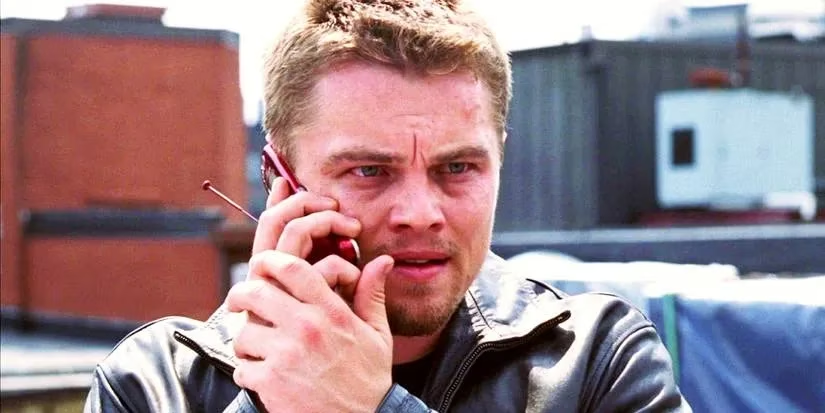
Miller's Crossing: A Noirish Dance of Ethics
The Coen brothers, architects of so many cinematic wonders, crafted one of their most underappreciated gems with Miller's Crossing. This neo-noir gangster story, set in the Prohibition era of 1929, is a intricate web of loyalty, self-interest, and fractured friendship. Its opening is a masterclass in tension, built not on gunfire but on dialogue. As Johnny Caspar declares, "I'm talking about ethics," in a room thick with cigar smoke and suspicion, the film announces itself as a layered, philosophical crime drama. The fast-talking debate among gangsters is like a chess game played with razor blades—every word a calculated move, every silence a threat. 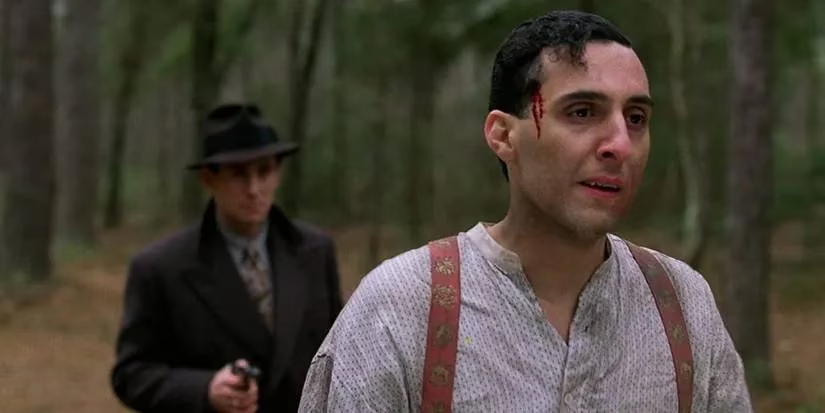
Mean Streets: The Birth of a Moral Universe
Mean Streets was the crackling fuse that ignited Martin Scorsese's career. Its first ten minutes are a perfect overture for the themes he would explore for decades. We meet Charlie, played by Harvey Keitel, torn between the sacred and the profane, his internal conflict scored to the defiant joy of The Ronettes' "Be My Baby." The opening cuts from the pulsating energy of the song to Charlie in the solemn silence of a church, his face a battlefield of Catholic guilt and criminal ambition. This collision of the spiritual and the streetwise signaled the arrival of a new Hollywood voice, one that replaced old studio conventions with raw, personal storytelling. 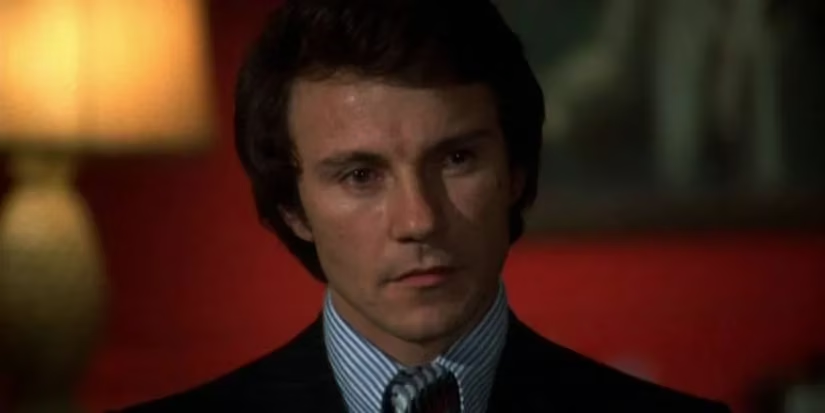
City of God: A Kaleidoscope of Trapped Futures
While English-language films often dominate the genre, the seismic impact of City of God is undeniable. This Brazilian epic charts the rise of organized crime in the Rio de Janeiro favelas through the eyes of Rocket, a boy who dreams of escape through photography. The opening scene is a kinetic, terrifying ballet. The vibrant pulse of Brazilian music clashes with the stark reality of children, armed and dangerous, chasing a chicken through narrow streets. The gunshots that ring out are not just sounds of violence but the ticking clock of stolen childhoods, laying the groundwork for inevitable lives of crime with brutal, breathtaking efficiency.
Eastern Promises: The Chill of Immediate Brutality
Following their collaboration on A History of Violence, director David Cronenberg and actor Viggo Mortensen reunited for the bleak and brutal Eastern Promises. Mortensen's Nikolai Luzhin is a ruthless enforcer in the Russian mafia, a man of few words and terrifying actions. The film wastes no time: a murder occurs within the first two minutes, a cold, clinical act that establishes a world where humanity is a liability. The story unfolds as a British midwife seeks the truth behind a teenage mother's death, pulling her into a shadowy world of trafficking and tribal vengeance. From its first breath, the film is as sharp and unflinching as the tattoos that map its characters' loyalties. 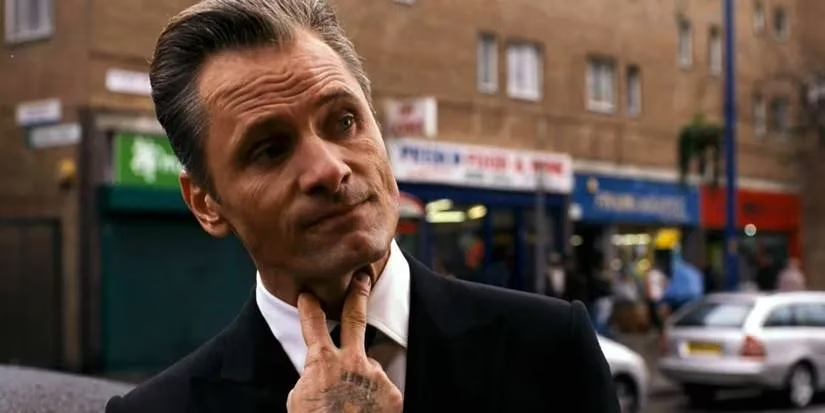
Once Upon a Time in America: An Opium Dream of Memory
Sergio Leone, having defined the spaghetti western, turned his mythic eye to the gangster film with his near-four-hour epic, Once Upon a Time in America. Its opening is a haunting descent into a fog of memory and regret. Gangsters interrogate a terrified man in an opium den, the haze of smoke mirroring the fractured, non-linear narrative to come. It sets the tone for a sprawling saga of Jewish gangsters in New York, a tale of betrayal and lost time that, though initially a commercial failure, has since been restored and rightly hailed as a masterpiece. Its beginning is like a half-remembered melody, beautiful and sorrowful, hinting at the grand tragedy to come.
The Godfather: The Quiet Calculus of Power
The Godfather is not just a gangster film; it is a cornerstone of cinema itself. Francis Ford Coppola's dark exploration of the American Dream and familial corruption announces its grandeur in a deceptively quiet opening. On the day of his daughter's wedding, Don Vito Corleone (Marlon Brando) receives supplicants in his study. The first, Amerigo Bonasera, seeks vengeance for his assaulted daughter. In this shadowy room, power is not shouted but whispered. Vito's lesson about friendship and respect, delivered in a voice like gravel wrapped in silk, establishes the film's core theme: that organized crime is, first and foremost, a business and a twisted form of family. The opening is a perfectly still pond, reflecting the immense, dark depths below. 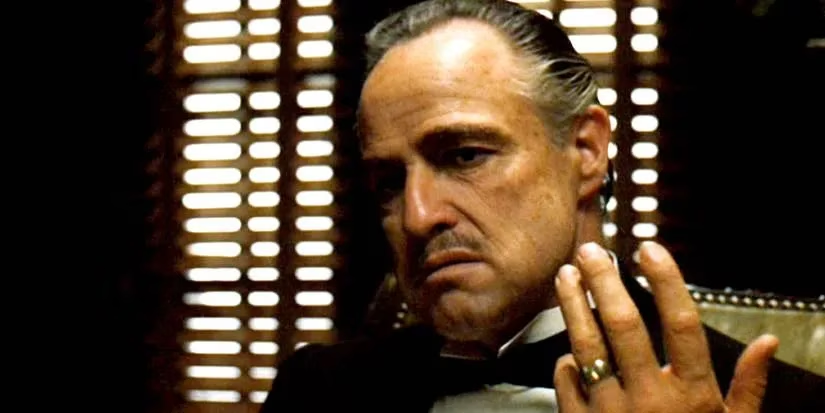
Goodfellas: The Giddy Descent into the Abyss
Martin Scorsese's Goodfellas throws the viewer headfirst into the violent, thrilling, and darkly comic world of the mob. It opens with a brutal triple act: a stabbing, a shooting, and Ray Liotta's Henry Hill delivering the iconic line, "As far back as I can remember, I always wanted to be a gangster." The juxtaposition is electric—savage violence immediately followed by a childlike declaration of aspiration. It was clear from these first minutes that Goodfellas would be a different beast: faster, funnier, and more intimately chaotic than its predecessors. Scorsese perfected his signature style here, depicting a world where charm and cruelty are two sides of the same blood-stained coin. The opening is a rollercoaster leaving the station, promising a ride that is both exhilarating and terrifying.
| Film | Director | Key Opening Element | Established Theme |
|---|---|---|---|
| The Departed | Martin Scorsese | Voiceover & Street Fight | Identity & Institutional Corruption |
| Miller's Crossing | The Coen Brothers | Ethical Debate Dialogue | Loyalty & Moral Ambiguity |
| Mean Streets | Martin Scorsese | Juxtaposition of Church & Street | Guilt & Moral Conflict |
| City of God | Fernando Meirelles | Kinetic Chase Scene | Cycle of Poverty & Violence |
| Eastern Promises | David Cronenberg | Immediate Murder | Brutal Realism & Tribal Codes |
| Once Upon a Time... | Sergio Leone | Opium Den Interrogation | Memory & Betrayal |
| The Godfather | Francis Ford Coppola | The Favor in the Study | Power, Family, & Business |
| Goodfellas | Martin Scorsese | Violence + "I wanted to be a gangster" | The Glamour & Horror of the Life |
In the end, the power of these openings lies in their economy and their promise. They are the first brushstrokes on a vast canvas, the opening notes of a complex symphony. They teach us the rules of their worlds—whether those rules are written in blood, whispered in shadowy rooms, or screamed in the vibrant chaos of a favela. Like a master magician revealing just enough to awe the audience before the real illusion begins, these directors use their opening scenes not merely to start a story, but to define an entire universe of consequence and fate. Decades after their release, these initial moments remain as potent as ever, proving that in the world of cinematic crime, the first impression is often a lasting, and lethal, one. 🎬 🔫 💎