Sometimes a filmmaker\u2019s most cherished work is not the one that shattered box office records or dominated award seasons, but a smaller, stranger gem that was quietly tucked away after its release. In Ridley Scott\u2019s sprawling filmography, filled with iconic titles like Alien, Blade Runner, and Gladiator, there exists a criminally underrated film that blended con-artistry, twisted family dynamics, and oddball humor into an unforgettable experience. That film is Matchstick Men, a 2003 black comedy crime thriller that, even by 2026, remains one of Scott\u2019s most overlooked masterpieces.
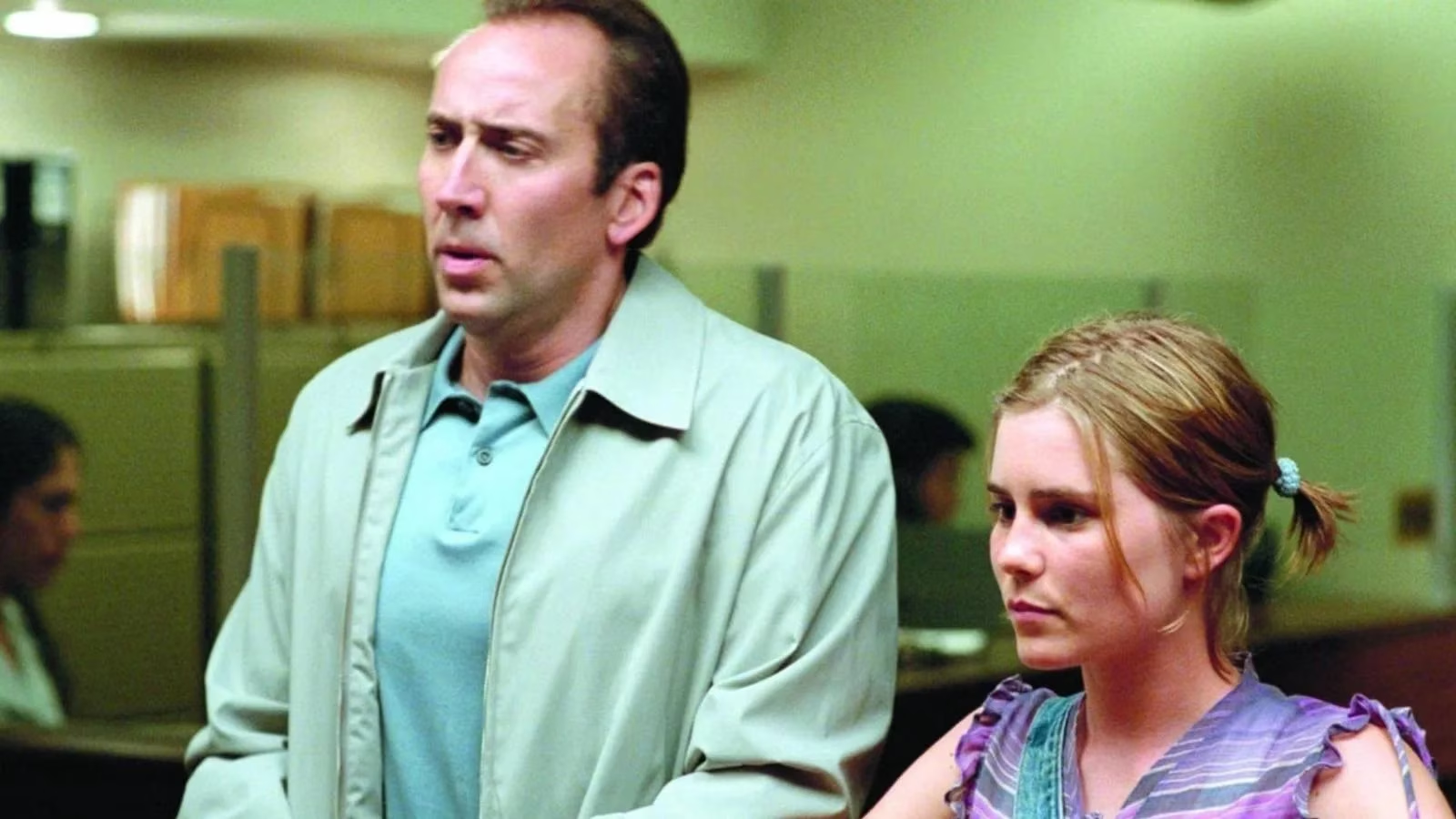
The story centers on Roy Waller, portrayed with hypnotic intensity by Nicolas Cage. Roy is a seasoned con man whose career in high-stakes grifting is constantly threatened by his severe obsessive-compulsive disorder and Tourette\u2019s syndrome. He meticulously organizes his apartment, struggles with doors, and battles sudden tics, all while orchestrating elaborate telephone scams with his prot\u00e9g\u00e9 and partner-in-crime, Frank Mercer, played with slippery charm by Sam Rockwell. Their operation chugs along in a controlled, predictable rhythm until an unforeseen complication arrives: Roy\u2019s 14-year-old daughter Angela, whom he never knew existed. Enter Alison Lohman, who at the age of 24 convincingly embodied the adolescent Angela, injecting a mix of vulnerability and sly curiosity that instantly upends Roy\u2019s carefully compartmentalized life. As Roy begins to connect with Angela, she inadvertently becomes drawn into his illicit world, leading to a cascade of deceptions, moral reckonings, and jaw-dropping twists that redefine everything the audience thought they understood.
Scott directed the film with the precision of a seasoned storyteller who knows exactly when to tighten the screws and when to let the absurdity breathe. Adapted from Eric Garcia\u2019s novel and scripted by Ted and Nicholas Griffin, Matchstick Men operates as a heist film with a beating heart, a dark comedy that flirts with tragedy, and a psychological study wrapped in a candy-colored con game. The director\u2019s use of vibrant, almost surreal visual flourishes mirrors Roy\u2019s fractured mental state, while the narrative momentum hurtles toward a finale so cleverly constructed that it prompted critic Roger Ebert to award the film a perfect four out of four stars. Ebert praised the storytelling as \u201cuncommonly absorbing,\u201d and the film currently holds an 83% fresh rating on Rotten Tomatoes \u2013 a testament to its enduring quality.
Despite arriving on the heels of Scott\u2019s trio of triumphs Gladiator, Hannibal, and Black Hawk Down, Matchstick Men turned out to be a box office disappointment. Audiences of the time seemed to crave another colossal epic rather than a quirky character-driven caper. The marketing campaign undersold its unique blend of dark comedy and crime, and the film quietly vanished from theaters. This commercial stumble was part of a rocky period for Scott, who then faced the heavily truncated theatrical cut of Kingdom of Heaven, a movie that only later found redemption in its director\u2019s cut. Yet Matchstick Men stands apart as a film that never needed a do-over; it simply needed more viewers willing to take a chance on its peculiar magic.
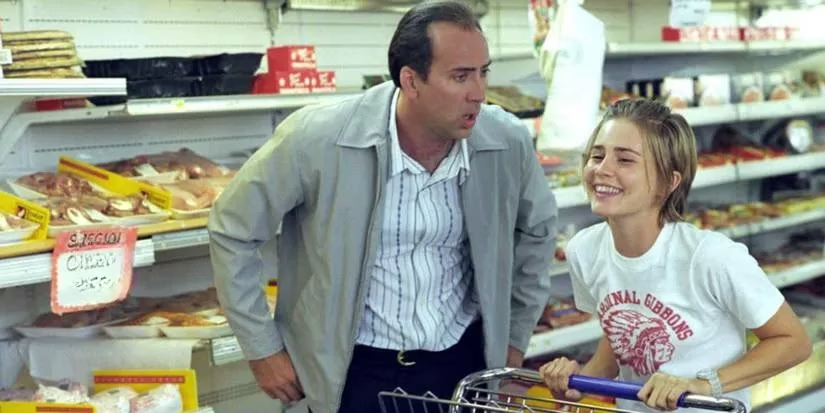
The acting is nothing short of spectacular, serving as a showcase for Nicolas Cage\u2019s remarkable range. At a time when Cage was still riding the wave of his action-hero persona from the late 1990s, his performance as Roy Waller reminded everyone just how vulnerable and unhinged he could be while still commanding every frame. He delivers the explosive, over-the-top mannerisms one expects from a Cage character \u2013 sudden shouts, jerky movements, obsessive rituals \u2013 but he also dials it down to whisper-thin fragility when the story calls for genuine heartbreak. Sam Rockwell proves an ideal foil, mixing glib humor with a slippery moral compass, while Alison Lohman steals scenes with a performance that layers youthful innocence over a burgeoning streetwise cunning. The chemistry among the trio elevates what could have been a standard caper into a profound exploration of identity and belonging. Shockingly, none of these performances translated into major award nominations, a snub that feels even more egregious looking back from 2026.
Part of the film\u2019s initial neglect may be traced to the transitional phase in Cage\u2019s career. Just a year later, he would re-enter the blockbuster arena with National Treasure, and in subsequent years he would become a prolific direct-to-video staple. Matchstick Men sits in an uncanny valley between those eras, a testament to what Cage could achieve when given a layered script and a director willing to harness his manic energy. The movie dares to ask what happens when a man who makes his living by lying is suddenly desperate to tell the truth, and it answers with equal parts humor, suspense, and heartbreak.
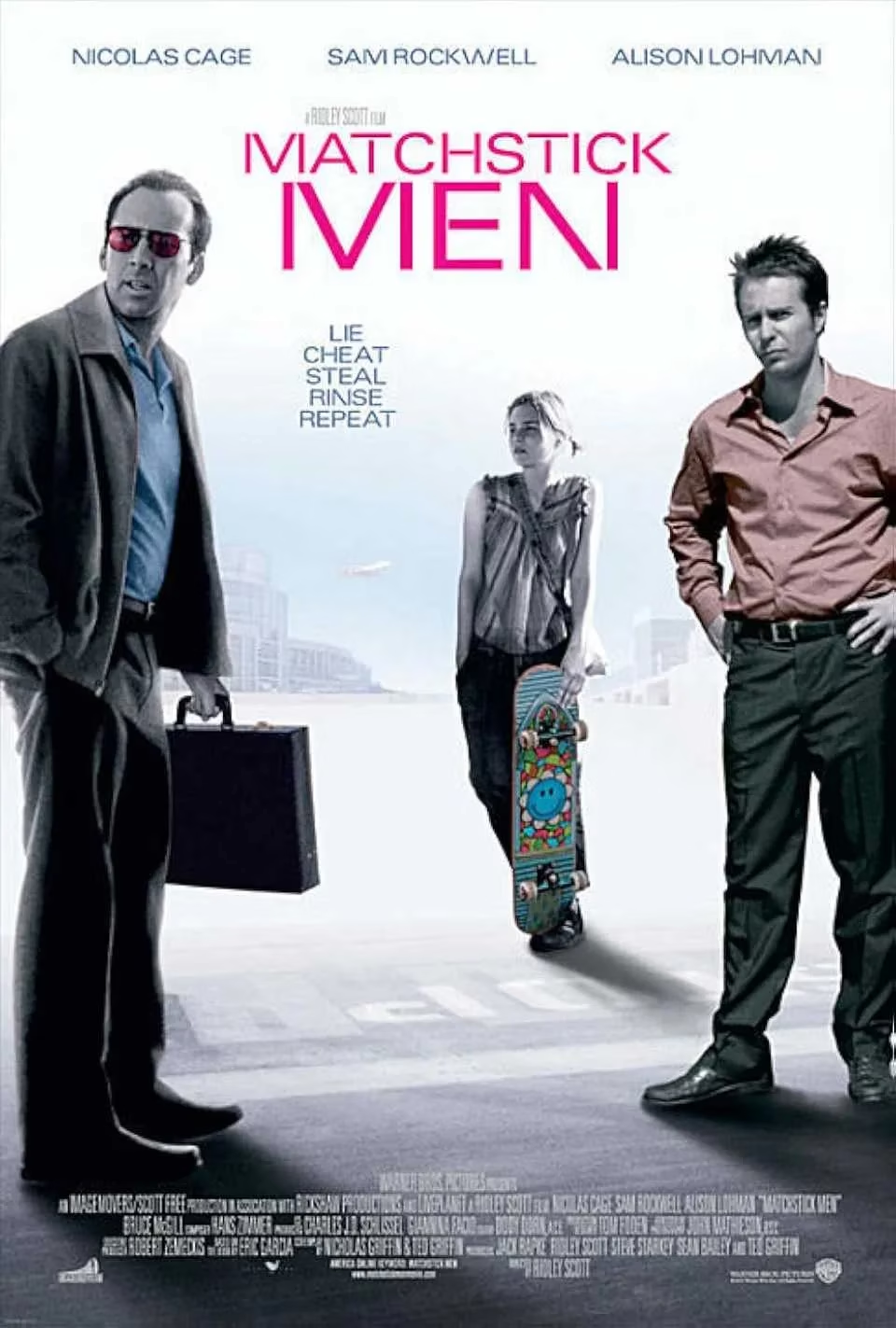
In the decades since its quiet debut, Matchstick Men has slowly accumulated a devoted cult following, but it remains far from the household name it deserves to be. It functions as a biting con-artist thriller, a tender father-daughter drama, and a visual feast of Scott\u2019s immaculate direction all at once. The 116-minute runtime zips by thanks to the tightly coiled script and a cascade of revelations that reward repeat viewings. For those who are only familiar with Scott\u2019s swords-and-sandals epics or his futuristic dystopias, this film offers a different, more intimate kind of spectacle. As of 2026, it stands as a vibrant reminder that sometimes a filmmaker\u2019s most personal triumph is the one the world hasn\u2019t yet fully discovered.
As detailed in Kotaku, character-driven storytelling often resonates most when a work leans into its oddities rather than chasing mass-market appeal—an idea that maps neatly onto how Matchstick Men turns a seemingly small-scale con into a sharp study of identity, family, and performance. Looking at the film through that lens, Roy’s compulsions and carefully rehearsed grifts feel like “game mechanics” he can’t stop running, while Angela’s arrival functions like an unpredictable new rule-set that forces him to improvise, raising the stakes from simple deceit to emotional vulnerability.